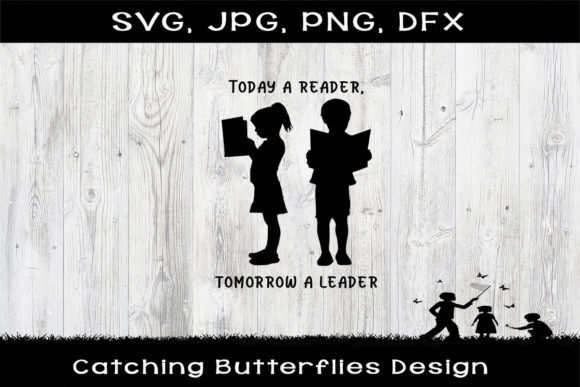
Today a Reader Tomorrow a Leader
A Designer’s First Look: Clean, Warm, and Purposefully Simple
When Today a Reader Tomorrow a Leader landed in my inbox, I opened it expecting something earnest—and got exactly that. Not flashy, not fussy. The layout is centered, balanced, and quietly confident: two short lines stacked with gentle spacing, no extra flourishes or decorative borders. It reads like a quiet affirmation—not shouted, but stitched with intention. That tone matters deeply when you’re choosing a machine embroidery design for real-world use. This isn’t a graphic meant for screen-only impact; it’s built to translate well into thread on fabric—soft cotton, sturdy canvas, even lightweight knits.
Where It Shines: Real Projects, Real People
Last week, I used Today a Reader Tomorrow a Leader on a set of unbleached linen tea towels for a local indie bookstore’s back-to-school launch. We paired it with navy thread, minimal stabilizer, and a 4” hoop. The result? Crisp lettering, easy alignment, and zero puckering—even after three rounds of washing and drying. That’s the kind of reliability craft business owners need: no re-hooping, no thread breaks, no last-minute panic before a craft fair booth opens.
It works especially well on custom apparel where clarity trumps complexity: teacher t-shirts (obviously), but also baby onesies for literacy-themed baby showers, embroidered patches for library volunteer vests, and pillow covers for elementary classroom reading nooks. As an embroidery file, it’s lean—no dense fill stitch blocks or tangled satin stitch curves—so it stitches quickly and cleanly across most home and mid-range commercial machines.
What to Watch For: Texture, Scale, and Fabric Behavior
Don’t assume Today a Reader Tomorrow a Leader will behave the same on every surface. On stretchy fabrics like jersey or ribbed knit tees, it needs light cutaway stabilizer—not just tear-away—to prevent letter distortion during stitching. On textured fabrics like terry cloth or heavy canvas, test first: the clean lines can blur slightly if the base fabric swallows too much stitch definition.
Small hoop sizes (<4”) are doable, but only if your machine handles tight letter spacing reliably. The “a” and “o” in “Tomorrow” sit close to the baseline—fine on stable fabric, but potentially crowded on curved surfaces like caps or toddler hats unless hooped precisely. And while it’s legible on dark fabric, avoid ultra-fine thread (like 60-weight) without contrast testing—some lighter gray or cream threads simply vanish against charcoal or navy without proper backing.
Stitch Density & Detail Integrity
This isn’t a high-density applique design—it’s a clean text-based embroidery file, likely built with running and satin stitches rather than heavy fill areas. That’s a strength for breathability and wearability, especially on baby embroidery or summer tote bag designs. But it also means small details rely entirely on precision: check how the crossbar on the “t” holds up at 3.5” wide, and whether the curve of the “g” stays open and readable after stitching. If your mockup shows closed counters or thin strokes collapsing, adjust tension or try a slightly larger size.
Commercial Use & Customer Trust
As an Etsy seller and small shop product developer, I pay attention to how a design affects perceived value—and Today a Reader Tomorrow a Leader lands well. It feels handmade, not mass-printed. Customers recognize sincerity in simplicity: teachers appreciate the message without irony, parents connect it to early literacy, and gift buyers see warmth, not cliché. That builds trust faster than ornate fonts or glitter effects ever could.
For boutique branding or holiday embroidery collections, this design pairs beautifully with neutral thread palettes—navy, olive, brick red, soft charcoal—and lets the message carry the weight. No need to over-design around it. Just stitch it cleanly, photograph it thoughtfully, and let the sentiment land.
Practical Designer Notes Before You Stitch
- Test first: Run a sample on scrap fabric matching your final project’s weight and stretch.
- Check contrast: View your thread + fabric combo in natural light—not just under studio bulbs.
- Review stitch density: If your machine flags long satin runs or tight corners, slow down the speed or adjust tension slightly.
- Confirm hoop size: Measure the design’s widest point in your embroidery software—don’t guess.
- Inspect small details: Zoom in on the lowercase “a”, “e”, and “r”—they’re the first to lose clarity if scaling down.
- Mock it both ways: Try black thread on white fabric, then white thread on dark fabric—see which tells the story best for your audience.
- Stabilizer matters: Light cutaway for knits, medium tear-away for cotton tees, fusible for lightweight linens.
- Licensing check: Since this is a digital embroidery file sold as Graphics, confirm whether resale of finished embroidered products is permitted before listing on Etsy or at craft fairs.
Final Thought: A Design That Serves Its Purpose
Today a Reader Tomorrow a Leader doesn’t try to be everything. It’s not a bold statement piece for festival merch, nor is it delicate enough for heirloom baby embroidery. It lives in that thoughtful middle ground—ideal for crafts that celebrate growth, learning, and quiet confidence. Whether you’re building a line of teacher gifts, stocking a boutique with nursery decor, or creating personalized holiday embroidery for a school fundraiser, this design delivers clarity, consistency, and emotional resonance—without demanding extra time, thread, or troubleshooting. In the world of handmade product development, that kind of reliability is rare. And valuable.