Stop Whining Start Grinding
A Designer’s First Look: Bold, Unapologetic, and Built for Stitching
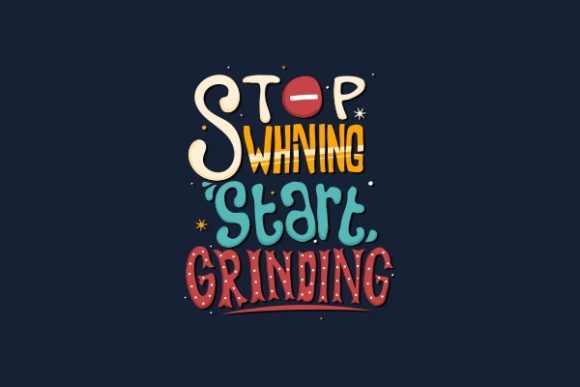
When Stop Whining Start Grinding landed in my inbox, I paused—not because it’s flashy or overly ornate, but because it lands with weight. This isn’t delicate script or whimsical doodle lettering. It’s hand-lettered with intentional imperfection: slightly uneven baselines, subtle tapering in strokes, and a grounded, no-nonsense rhythm. As an embroidery designer who’s stitched hundreds of quote-based designs for clients and my own craft business, I immediately saw its potential—and its limits. It reads like something you’d embroider on a heavyweight cotton tote for a small-batch boutique, not a dainty onesie for a newborn.
Real Project Test: A Custom Sweatshirt for a Local Fitness Studio
Last week, I prepped Stop Whining Start Grinding for a client—a women-led strength training studio launching limited-edition crewnecks. We chose midweight fleece sweatshirts in charcoal gray. Before hooping, I reviewed the design as a machine embroidery design: moderate height (roughly 3.5" tall at standard scaling), open letterforms, and generous spacing between words. That breathing room saved us. On dense fleece, tight kerning would’ve collapsed into muddy fill stitch; here, each letter held its shape. The satin stitch outlines stayed crisp, and the fill stitch density felt balanced—no puckering, no thread buildup. Customers responded strongly to the phrase itself, yes—but more importantly, they noticed how *clean* the stitching looked. That’s professionalism you can’t fake.
Where It Shines (and Where It Needs Caution)
Stop Whining Start Grinding works best where attitude meets durability:
- Custom apparel: Sweatshirts, structured tote bags, denim jackets, aprons—fabrics that support bold lettering without distortion.
- Small shop product: Ideal for Etsy sellers offering minimalist, motivational merchandise. It reads clearly in thumbnail mockups and translates well to printable mockups for listings.
- Embroidered patch: Clean edges and strong negative space make it highly adaptable for iron-on or sew-on patches.
- Holiday embroidery: Surprisingly effective on neutral-toned kitchen towels or linen pillow covers for “motivational hostess gifts.”
But tread thoughtfully in these situations:
- Baby embroidery: Too assertive in tone and scale for infant wear—skip the onesies and bibs.
- Thin or stretchy fabric: Avoid lightweight knits or jersey unless heavily stabilized. Letterforms may distort during stitching or wear.
- Curved surfaces: Caps and beanies demand tighter curves and smaller letter heights. This design’s width and stroke weight don’t adapt well without significant resizing—risking legibility loss.
- Dark fabric + light thread: Works, but test contrast first. Some versions of this digital embroidery file use fine interior details that vanish on black without careful thread color selection.
Design Integrity Meets Handmade Presentation
What makes Stop Whining Start Grinding stand out among inspirational quote graphics is its restraint. There’s no decorative border, no clipart flourish, no forced “vintage” texture. That minimalism strengthens its handmade presentation—it looks intentionally designed, not templated. For craft business owners, that builds customer trust. Buyers recognize effort, clarity, and intention. When used on a custom embroidered tote bag or boutique-branded apron, it signals confidence—not just in the message, but in the maker’s eye for balance and execution.
Practical Embroidery Designer Notes You’ll Actually Use
Before stitching Stop Whining Start Grinding into your next project, do these five things:
- Test on scrap fabric first, especially if using textured weaves (like canvas or terry cloth) or layered garments (e.g., hoodies with pockets).
- Check thread color contrast across multiple backgrounds—try it in black thread on oatmeal linen and white thread on navy twill. Not all combinations hold up equally.
- Review stitch density in the lowercase “g” and “r”—those curved terminals are common snag points on low-stabilizer runs.
- Confirm hoop size compatibility. If your machine’s smallest hoop is 4x4", this design likely fits—but verify before digitizing or scaling down.
- Inspect small details in grayscale. View the embroidery file as a black-and-white vector or bitmap preview. If the “i” dot or crossbar on “t” disappears at 75% zoom, it may not resolve cleanly in thread.
Also: double-check licensing. Since this is listed under Crafts and Graphics, confirm whether commercial use—like selling finished embroidered sweatshirts on Etsy—is permitted. Many designers assume “for personal and commercial use” unless stated otherwise, but never skip verification.
Fitting the Phrase to the Product—Not the Other Way Around
The strongest insight I’ve gained from using Stop Whining Start Grinding repeatedly? It doesn’t suit every product—it suits the right audience, at the right moment. It lands powerfully on gear for gym-goers, workshop tools for makers, or staff aprons for coffee roasters who value grit over gloss. It feels hollow on a baby shower gift or a wedding favor. That’s not a flaw—it’s focus. As a designer, I appreciate when a digital embroidery file knows its lane. It saves time, reduces rework, and helps me guide clients toward authentic, resonant handmade product choices.
Final Thought: Clarity Over Cuteness
In a market saturated with cursive quotes and pastel affirmations, Stop Whining Start Grinding stands apart by choosing clarity over cuteness, structure over softness, and utility over ornament. It’s not for everyone—and that’s precisely why it works so well for the people who need it. Whether you’re an Etsy seller building a cohesive line, a small shop product curator selecting embroidery assets, or a hobbyist stitching motivation into everyday objects, this design earns its place—not through novelty, but through honest, stitch-ready execution.